
How did YOU find your way to becoming a masseuse?
It wasn't until a few years ago, even though my mother is a trained reflexologist. I remember when I was 20 years old that I was sure that this way of working with the body was something I never wanted to do. But I've always danced, so body awareness and the interest have always been there. As a dancer at a higher level, you help each other with both stretching and muscle relaxation, and I've always found that exciting and important. So that was the start.
I received my dance education from Eva Aalbæk Nielsen, who also works here at the Health and Sports Clinic, and from Leeds in England.
A year ago I started a supplementary body and trauma course with Eva and it hooked me. Then the path was paved to education and work as a masseuse.
One of my professional interests is finding the connection between body and soul. People may come in with the problem that their shoulder hurts, but during treatment it turns out that it goes deeper.
My dance education started "late" from a dance perspective, but it has also meant that from the start I have registered how much "awareness" there is in the body, and how to work with it by using the body to see through the physical/mental challenges.
What do you use from dance in your treatments here at the Clinic?
Pauses, pace!
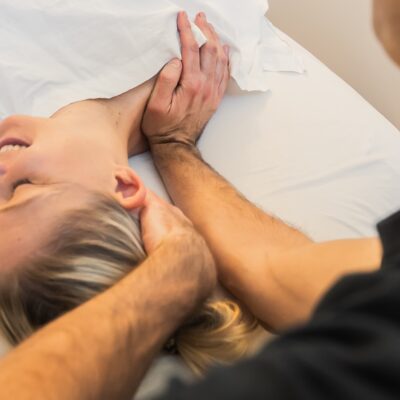
I work with tempo and pauses which are an important part of an effective massage. As in my dance, I make sure that pressure and touch are coherent. And then I don't just use the finger muscles to massage, but get my body to work with the massage.
How did you experience the clinic?
A nice place, quiet and you feel welcome. The clinic has a good reputation. I have experienced quite a few new clients who come in and have heard in advance from others that it is a good place.
Can you name a treatment where “your” method made a difference?
I recently had a client with shoulder pain. But I let my 'fingers' do the talking, so even though we started at the shoulder, the fingers found the spot in the back where the problem originated. The client called it intelligent fingers, and I take that as a big compliment, and was of course very happy when he said that.
When can new clients book in?
Until now, I have mostly worked on Saturdays, but from now on I will also have treatment hours on Mondays and Wednesdays, in the evenings. I know from myself that it is important to be able to receive treatment, even outside of regular working hours.
Finally, the question that must be included, your name?
My father was and is a huge fan of David Bowie, so when I was to be baptized, they tried the name Ziggy (from David Bowie's big hit Ziggy Stardust). But with the Y at the end, it was a boy's name back in the 80s, so Ziggie. The surname Søvsø is a Jutlandic family and clan name from the town of Stoholm near Viborg.