Round, red marks after a treatment are probably what most people associate with cupping. But behind the characteristic marks lies an effective form of treatment that has been used for millennia – and which today is included as a natural supplement to massage with us.
What is cupping?
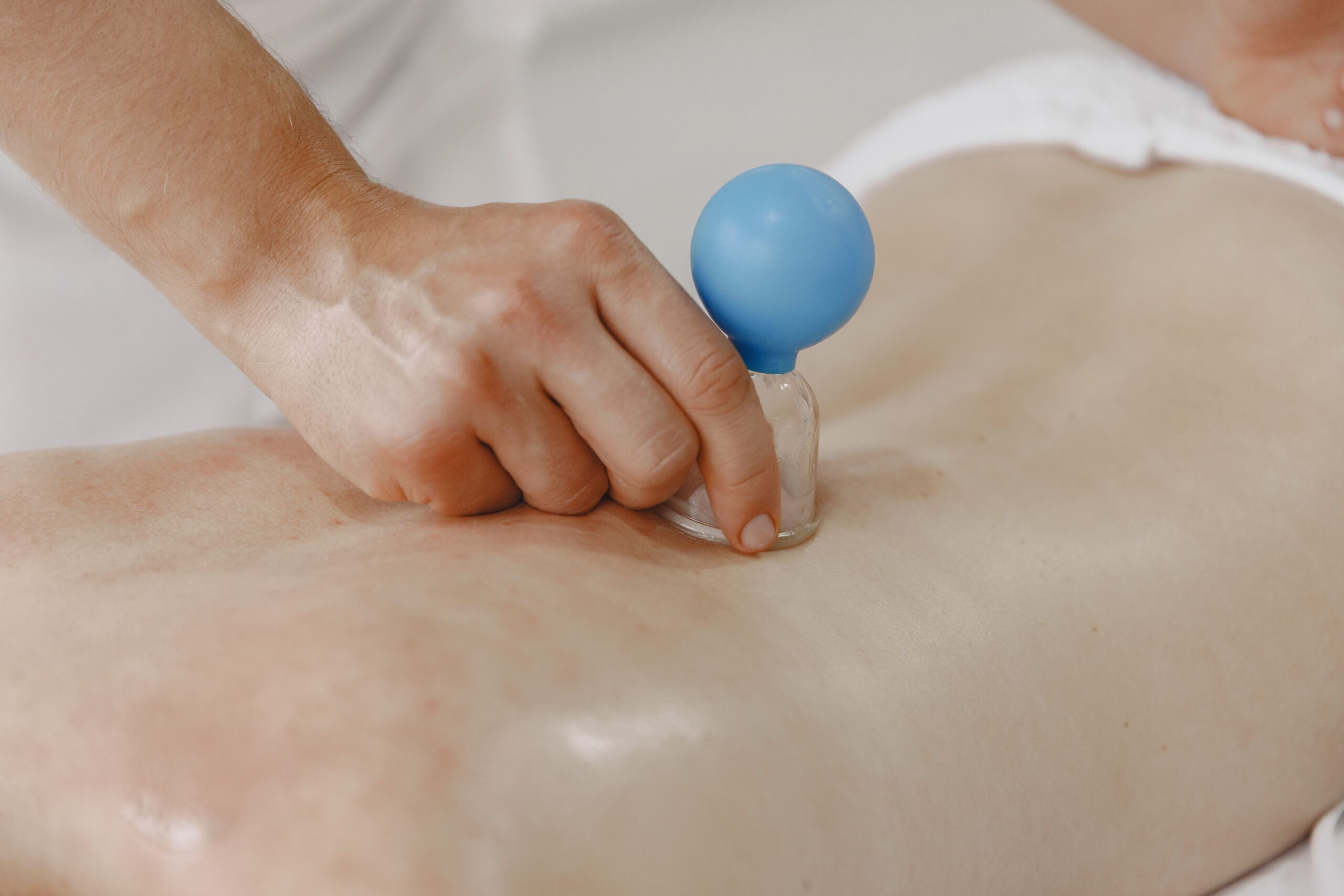
Cupping – also called vacuum therapy or cupping – is a form of treatment where suction cups are placed on the skin and create negative pressure. The negative pressure pulls the skin and underlying tissue up into the cup, unlike regular massage, which works by applying pressure into the tissue.
The method originally originated from traditional Chinese medicine, but is now widely used in both physiotherapy and massage, partly because several elite athletes have made the characteristic marks visible after major competitions.
How does it work?
The negative pressure in the cup has several effects on the tissue:
- Increased blood flow: The suction draws more blood to the area, which can speed healing and reduce tension.
- Loosening fascia and connective tissue: Cupping can loosen stuck connective tissue that otherwise limits movement.
- Deep muscle release: Because the technique pulls upwards instead of pressing down, it can reach tensions that are difficult to reach with regular grips.
The red or purple marks after the treatment are not bleeding like after a stroke, but a sign of extra blood flow to the tense areas. They usually disappear within a few days.
What can cupping help with?
We typically use cupping as a supplement to massage for:
- Chronic muscle tension that does not resolve with regular massage alone
- Reduced mobility due to tight connective tissue
- Recovery after hard training or sports
- Poor local blood circulation in the muscles
Cupping or regular massage – what should you choose?
The two methods are not mutually exclusive; on the contrary, cupping is often used as a supplement within or after a physiotherapy or deep massage. If you choose cupping alone, it is typically because you specifically want to work with connective tissue and circulation rather than the broad relaxation that a classic massage provides.
If you are in doubt, we always recommend talking to your therapist first, so that together you can find the combination that suits your specific tension.
Who should be careful with cupping?
Cupping is gentle for most people, but should be avoided or adjusted for:
- Open wounds or skin irritation in the affected area
- Blood thinning medication
- Pregnancy, unless specifically agreed with the practitioner
- Very thin or fragile skin
Always tell your therapist if you are undergoing medical treatment or have health concerns so that the treatment can be adapted to you.
Try it yourself
Cupping is one of the treatments where most people can quickly feel a difference, both in mobility and tension levels. If you have any questions, please feel free to call 45 88 88 50 or write to klinikken@hiklin.dk.